
Pursuing a Master of Business Administration (MBA) from a reputed institute helps students develop the skills and knowledge needed to gain a competitive advantage in the corporate world. With organizations increasingly seeking professionals who possess strategic thinking, analytical abilities and leadership skills, pursuing an MBA has become a valuable investment for career growth. MBA education is broadly divided into two parts.
The first part includes core fundamentals which covers Marketing, Finance, HR, Operations, Managerial Economics etc, whereas, the second part includes electives and specialisation subjects.
MBA is a 2-year postgraduate degree that focuses on business management, leadership, and administration. It prepares students for careers in management, consulting, finance, marketing, operations, and entrepreneurship. It is designed to prepare graduates for management and leadership roles across many industries.
Also Read: MBA After Engineering: Complete Guide for B.Tech Graduates
Vikram Sarabhai Institute of Engineering & Technology (VSIET) has conducts 2-year full-time MBA programme. It offers Finance, Marketing, Operations Management, and Human Resource Management specialisations.
Latest curriculum of MBA includes artificial intelligence, data analytics, and digital transformation tools directly into business problem-solving and decision-making frameworks that felicitate the company’s requirements.
MBA Admission Eligibility:
Admission eligibility for an MBA is based on academic qualification, minimum percentage requirements, and valid entrance exam scores. MBA is normally 2 years duration and Executive MBA is of one year duration. A bachelor’s degree from a recognised university with at least 50 % marks is basic requirement of most of the institutions. Some premiere institutes require 80 – 90 percentage of marks as basic requirements.
Admission is based on CAT – Common Aptitude Test, examination in premier institutes. Most of the institutes usually admit students through entrance examinations such as CAT, CMAT , XAT, MAT, SNAP etc. Entrance examination test score followed by Group Discussion (GD) and Personal Interview (PI) is usual process of selecting students to MBA Admission 2026.
Also Read: MBA vs PGDM: Which is Better for Your Career?
Final-Year Undergraduate Students are eligible to apply provisionally, provided all degree exams are completed before joining and final proof of passing is submitted within the college’s stipulated deadline. If students wanted to do MBA in abroad, then they have to give GRE or GMAT and English proficiency tests in addition to the basic requirements.
Top MBA Specializations:
The popularity of an MBA specialization depends on salary potential, recruitment volume, and industry growth. Broadly, the most famous and sought-after MBA specializations are divided into traditional power houses and tech-driven modern tracks. Specialisation such as Marketing, Finance and Operations are traditional, whereas, Business Analytics, IT and Fintech are tech-driven.
MBA offers a wide range of specializations, allowing students to develop expertise in specific business functions. Most popular specialisations are Finance, Marketing, Business Analytics, Operations Management, and Human Resource Management. Other specialisations are Information Technology, International Business, Healthcare Management, Retail Management, and Entrepreneurship.
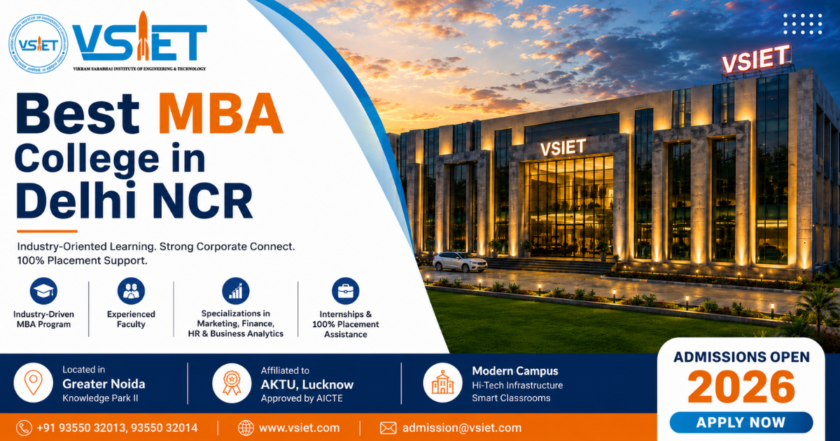
Also Read: Best MBA College in Delhi NCR – VSIET
Student must choose any one or two specialisations usually in their second year of MBA. Students have to choose the right specialization based on their aptitude and background. Quantitative and engineering backgrounds pair well with Business Analytics, Operations, or Finance. Creative and interpersonal profiles align better with Marketing or HR.
MBA Course Fees:
Fees for MBA Admission 2026 heavily depends on the institutes and locations. Fees in top IIMs (Indian Institute of Management) ranges from Rs. 17 Lakh to 29 Lakh. For Example, IIM Ahmadabad charges Rs. 28.50 Lakhs. Fees in top private colleges ranges from Rs. 20 Lakh to 43 Lakh. For example, Indian School of Business (ISB), Hyderabad charges Rs.39 lakh to 43 Lakh. Government institute charge Rs. 2 Lakh to 5 Lakh as fees for their MBA course.
Also Read: Top MBA Specialisation with Highest Salary in India
For example, Fees for MBA is Rs.2.5 Lakh in Faculty of Management Studies (FMS), Delhi. VSIET’s fees for MBA course is Rs.5.80 Lakh which includes international tour, latest configured laptop, book bank, etc. Education loans are available for almost all colleges. All Tier-1 and Tier-2 Indian business schools fall under Premier loan schemes from major banks offering collateral-free loans up to Rs. 20L– Rs. 40L.
Top Career Opportunities After MBA
Career growth and career opportunities are great after doing MBA. An MBA opens doors across virtually every corporate sector, tech domain, and entrepreneurial path. After an MBA, students can work as, Marketing Manager, Finance Manager, HR Manager, Operations Manager, Business Analyst, Product Manager, Management Consultant etc. The best career path depends on the specialization, skills, and work experience.
Also Read: Why AICTE Approval and AKTU Affiliation Matter Before Taking Admission
Companies are recruiting fresh and experienced MBA graduates with management skills. Companies like Tata Consultancy Services, Infosys, Accenture, Deloitte, EY, KPMG, Amazon, HDFC Bank, ICICI Bank, Aditya Birla Group etc, are the major recruiters. The highest career growth are found in, Business Analytics & Data Analytics, Product Management, AI Intelligence & Digital Transformation, Financial Management & FinTech, Digital Marketing, Supply Chain & Logistics, Consulting and Healthcare Management.
Conclusion:
MBA graduates often see a 50% to 150% increase in starting compensation compared to non-MBA roles, with Tier-1 Business schools offering average domestic packages ranging from Rs. 20L to Rs. 35L in 2026.
MBA graduates are in high-value professional network, are often connects directly with a global alumni network, C-suite executives, corporate recruiters, and ambitious peers across diverse domains. MBA graduates quickly move to executive roles placing towards senior manager, Director, VP and C-Suite positions. MBA graduates are having easy access to university incubators, seed funding networks, pitch platforms to launch new business ventures.
Frequently Asked Questions (FAQ):
1. What is the eligibility for MBA Admission 2026?
Ans: A bachelor’s degree from a recognized university is required to apply for MBA Admission 2026.
2. What are the eligibility criteria for admission to MBA Edge?
Ans: Candidates must hold a Bachelor’s degree with at least 50% marks (45% for SC/ST). Admission is based on CUET/UPCET scores, with management quota admission available as per university guidelines.
3. What MBA Edge specializations are offered at VSIET?
Ans: MBA Edge program at VSIET offers specializations in Marketing, Finance, Human Resources (HR), and Operations Management.
4. What are the top career opportunities after an MBA?
Ans: An MBA opens career opportunities as Marketing Manager Financial Analyst Human Resources (HR) Manager Operations Manager Business Development Manager Product Manager Management Consultant Supply Chain Manager Investment Banker Entrepreneur / Startup Founder & many more.
5. Does VSIET provide placement support for MBA students?
Yes, VSIET provides dedicated placement support through its Training & Placement Cell. Students receive aptitude and technical training, soft skills development, mock interviews, resume building, internships, and industry exposure. The institute has 250+ recruiting partners and focuses on preparing students for successful careers with strong placement opportunities.